Wednesday, 17 November 2010

Foggy morning

As part of the background research for this course I came across the work of a photographer called Brassai.  He undertook a projet photographing Paris by night.  The images are all sharp with great attention to detail. I was particularly taken with one image - foggy Paris (1934).

Although not at night the fog on Tuesday morning presented an opportunity to think further about images in difficult conditions. 


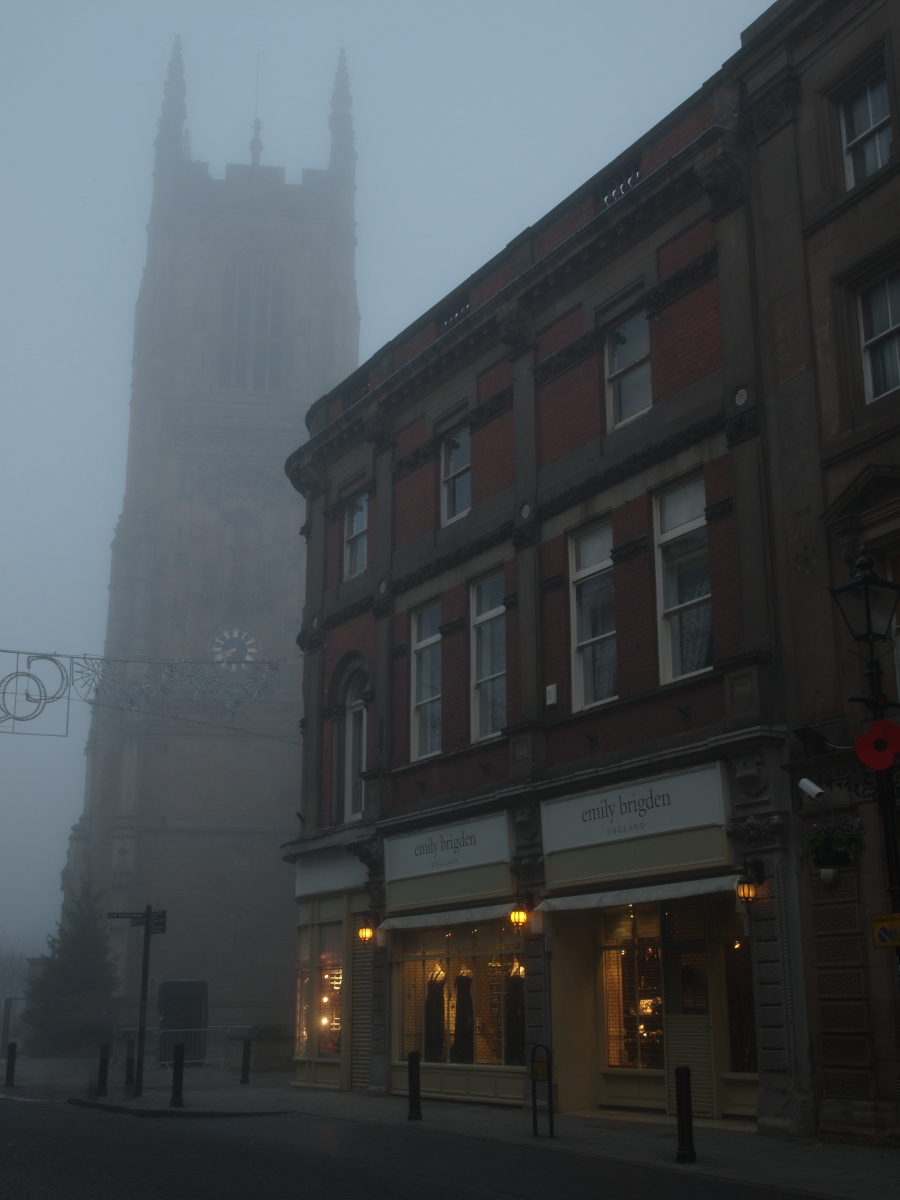
Foggy morning, Derby
14mm, 1/30th, F3.5, ISO400 

Strong centreground with detail in forground and back ground; the centre leading away from where the image was taken.


Foggy morning, Derby ii
21mm, 1 Sec, F16, ISO100 

No street lighting; the lights in the shop window have an old fashioned yellow/orange glow.  Strong foreground with the fog blurring bachground detail gives a greater feeling of depth to the image.


Melbourne Pool
14mm, 1/15th, F16, ISO200 

The sun had risen, but not burnt off the fog making the sky very bright behind the subject.  The colour image is almost sepia.


Melbourne Pool ii
17mm, 1/15th, F16, ISO200 


Foggy morning on the way to Leicester
34mm, 1/60th, F16, ISO200 

I wish! (Brassai 1934)

Monday, 15 November 2010

Gleam - Festival of light Derby

I read about the Festival of Light in a newsletter that I receive at work.  This is part of an arts festival in the city of Derby. It presented an opportunity for me to practice photographing buildings at night.

Specific techniques to be practiced include low light photography and use of a tripod.  Although image capture would be colour the intention was to look at the possibility of B & W conversion to look at replicating the feel of some of the works of Brassi that I had seen during research.

This is a public event so it will be necessary to be aware of the public as well as equipment when considering safety.  Weather is cold so warm clothing required.

The Gleam festival was using buildings within the Cathedral Quarter of Derby as the backdrop for a series of light shows.  In order to capture elements of the moving light show I would use longer exposures 15-30seconds.

The camera that I am using has image stabilisation built into the body.  As I will be using a tripod this is to be turned off. 


Derby Cathedral
Gleam event i
15mm, 15sec, F5.6, ISO400


The buildings were being illuminated by a series of moving lights.  By using long exposures of 15-30 seconds it allowed the overall pattern to be recorded.  I had read about a similar technique in a photography magazine where specific sections of a building had been highlighted by firing a flash-gun a different sections of the building while the shutter remained open.  It has proved very effective with these images.  The lenth of exposure has allowed a lot of detail to be captured, however the clouds have become blurred as they have moved.


Derby Cathedral
Gleam event ii
15mm, 15sec, F5.6, ISO400


Derby Cathedral
Gleam event iii
25mm, 15sec, F86, ISO400

Derby Cathedral
Gleam event iv
17mm, 15sec, F8, ISO400


Derby Cathedral
Gleam event v
14mm, 15sec, F8, ISO400


Derby Cathedral
Gleam event vi
14mm, 30sec, F8, ISO200


Gleam event vii
19mm, 4sec, F8, ISO200


Gleam event viii
33mm, 4sec, F8, ISO200


Gleam event ix
14mm, 1sec, F5.6, ISO400


Gleam event x
42mm, 4sec, F5.6, ISO400

Gleam event xi
26mm, 30sec, F8, ISO100


Gleam event xii
31mm, 15sec, F5.6, ISO100


Focusing the camera manually at night proved to be a challenge.
Gleam event xiii
31mm, 8sec, F5.6, ISO100

Gleam event xiv
32mm, 4sec, F8, ISO400

Sunday, 14 November 2010

Ezra Stoller

 Last Thursday Steve suggested that I take a look at Ezra Stoller as an example of a highly influential architectural photographer.

Ezra Stoller, architectural photographer, was born on May 16, 1915, He died on October 29, 2004, aged 89.  His full obituary can be found here http://www.timesonline.co.uk/tol/comment/obituaries/article391853.ece

The first para says it all really:

EZRA STOLLER was the American architectural photographer whose memorable photographs of buildings by the 20th century’s leading designers popularised architecture for a whole generation. His striking black and white photographs, which are among the world’s most frequently reproduced architectural images, played a key role in the shaping of public perceptions of modern architecture. 


Ezra Stoller, architectural photographer,  1915 - 2004

Many of the images taken by Stoller are very striking images of modernist style buildings, typified by clean strong lines.  At first glance the images look almost simple.

Reading through various articles about Stoller it becomes apparent that he took great care to plan the images that he took.  He would visit sites many times to explore the site itself, how it reacted to the light at differing times of day and as can be seen in this image how the building reacted with shade and shadow.

The image above is one of the few that had a person in it.  Then you realise that this is also planned, as without the person there is nothing to judge scale.  As you start to deconstruct the initial simplicity you see the adoption of rule of thirds, both horizontally and vertically, triangles, stripes, reflection, shadow, shade; all of a sudden it becomes less simple.


Whorls into an abstract form: A 1959 photograph by Ezra Stoller of Frank Lloyd Wright's Guggenheim Museum.

TWA Terminal, New York, 1962

Why / how it this strong style appropriate to my theme of community buildings that cover so many periods of architecture?  As I look deeper, past the commonly occuring images the light begins to dawn.

This image from an earlier post has some similarities in perspective and composition, but is also a world away.  Need to reflect more on shadow, use of light and reflection and how they can emphasise different aspects of the subject.


Use of shadow to focus the eye adds real depth to this image.  There is incredible depth of field with both foreground and background remaining sharpe, but destinct. 

Bell wharehouse - How do you make a box interesting?  Add foreground, perspective and blocks of colour.

Although this is removed from many of the images I was able to find, taken by Stoller, this and the the folllowing image have made me think more about my theme.

Graham House, 1962
This is very different from many Stoller images -still the modern architecture, but the setting becomes almost as important.


And finally.................

While  looking for images taken bt Syoller I came accross this image by Balthazar Korab

Saturday, 13 November 2010

Barrow upon Trent

The forecast for the weekend is mixed, best Saturday morning - getting greyer and wetter as the day / weekend progresses. 

The aim is to capture external images images from around the site of the church at Barrow upon Trent.  This church dates back to the 11th century.  The architecture is less ornate than later buildings and is early Norman in style.  There have been some alterations over time, but most are old and form part of the character of the building.

The site has been visited on a number of occasions to gain an understanding of what is there and how colours chnge with differing light conditions.  The site is open with some trip hazards otherwise fairly safe paths. I have spoken with a keyholder for the church and have arranged access at a later date to photograph the inside of the building in exchange for access to any images.  This visit is to capture external images.  Equipment to be used is Olympus EP-1 + standard kit lens, Poloriser and tripod. 

The building is of a pale stone and the aim was to enhance colour, taking advantage of early morning light.  In practice, although the morning was bright it had characteristics of later in the year, being very pale, with none of the autumn gold that I had hoped for.  The cirrus clouds were almost wintry, closely followed by a solid bank of cloud that indicated an approaching weather front.

This first image is taken of a gate that is set into the curtain wall of the cemetery.
Barrow upon Trent i
25mm, 1 sec, F5.6, ISO100


There was a very short window of time where the light added some colour to the stone of the church.
Barrow upon Trent ii
19mm, 1/4th, F11, ISO100

Some of the history is there to be seen by those who have the ability.

Barrow upon Trent iii
33mm, 1/2sec, F8, ISO100


Barrow upon Trent iv
20mm, 1/2sec, F16, ISO100

The sky became wintry.  I was not able to achieve what I had hoped with the building.  It did give an opportunity to attempt photographing silhouettes against the sky.  Used small aperture to increase depth of field and to allow elatively slow exposure without bleaching the sky.

Barrow upon Trent v
14mm, 1/15th, F16, ISO100

Barrow upon Trent vi
22mm, 1/3rd, F16, ISO100

Tuesday, 9 November 2010

Before the game


Small personal project, additional practice; buildings and people.  It has to be before the game, I'm there to watch - perspective in all things.

The aim of this project was to capture images of he industrial structure that is Twickenham as well as images of people connected with the event and the day.  The space will be open public space with large crowds.  Safety concers are general  - traffic, people etc.  Equipment - EP-1, standard lens and circular polorising filter.  Chosen for ease of use, forecast bright conditions and photographing in crowds without drawing too much attention.

Stadium structure       
28mm, F8, 1/60th, ISO 200

Pipeworks           
25mm, F8, 1/60th, ISO 200

Skyline               
26mm, F11, 1/60th, ISO 200

Starters Orders         
39mm, F5.4, 1/30th, ISO 200

Inclusive shade        
42mm, F8, 1/60th, ISO 400

Seated early            
34mm, F5.6, 1/60th, ISO 400

England Expects         
35mm, F5.3, 1/30th, ISO 400

Monday, 1 November 2010

Ansel Adams

There are no rules for good photographs, there are only good photographs.


A good photograph is knowing where to stand.


A photograph is usually looked at - seldom looked into.

Sometimes I do get to places just when God's ready to have somebody click the shutter.


Ansel Adams was a serious perfectionist, sometimes taking days or weeks over the taking and developing one photograph.  Much of his photography was black and white developing using gelatin silver.

Many of the quotes that I have been able to find are about photography being self-expression not use of rules.  The images all have incredible depth, almost a 3-d quality about them.  The tonal range in each image is very exact.  Adams writes about using the step wedge system to ensure that the tonal range for each image is as close as it can be to what was seen. 


Each element of the image compared to exposure readings taken at the time and measured against a known grey-scale - the step-wedge.

Having said that there are no rules it is still possible to see influence in some of the image compositions.  Placement of subject or horizons approximating to third lines.  For me one of the striking things is the shear scale of the image captured.